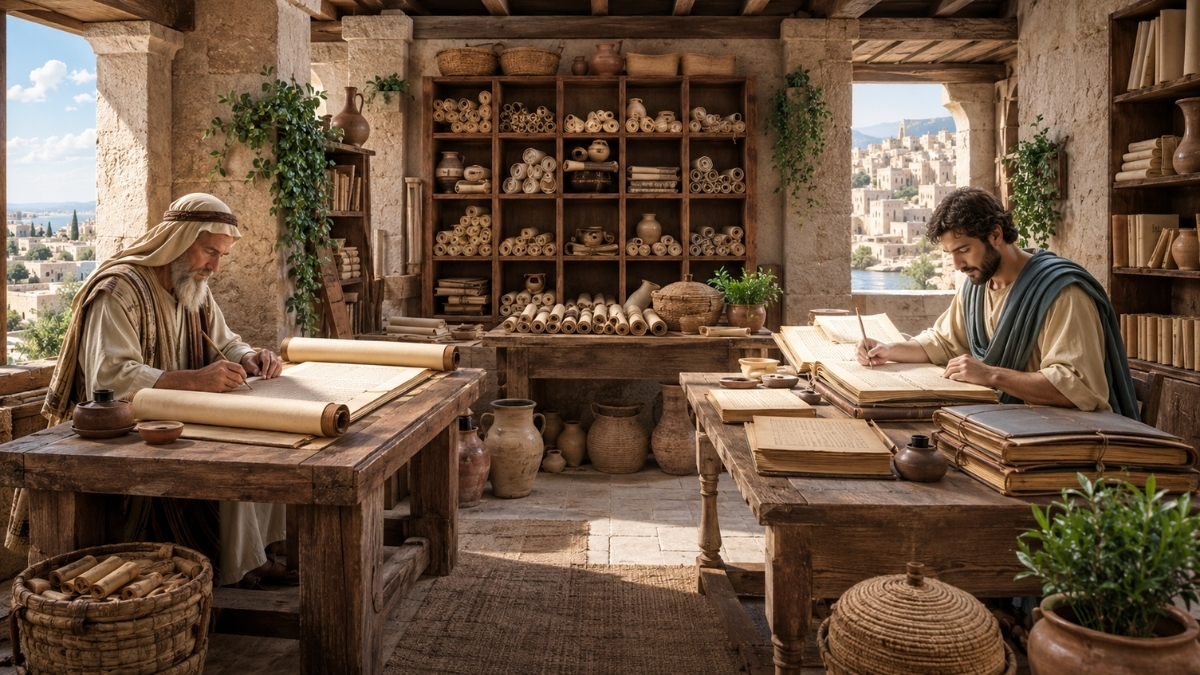
The Old Testament.—There are two Syriac translations of this part of the Bible, one made directly from the original language Hebrew, and the other from an ancient Greek version. The Syriac New-Testament Versions.—These we may conveniently enumerate under five heads, including several recensions under some of them, but treating separately the notable “Curetonian text.”
Textual Studies of the Hebrew Bible
The Old Testament, the inspired Word of God, how was it copied, maintained as to the textual reliability, and handed down throughout the past three thousand five hundred years?
OLD TESTAMENT TEXTUAL STUDIES: The Aramaic Targums
The “Targums” were loose translations or paraphrases of the Hebrew Old Testament Scriptures into Aramaic. Although fragments of the early Targums of some books were found among the Dead Sea Scrolls, the Jewish Targums as a whole likely found their current form no sooner than about the fifth century C.E.
Papyrus Fouad 266 Is a Greek Septuagint Copy of the Pentateuch
Papyrus Fouad 266 is a copy of the Pentateuch in the Greek version of the Hebrew Bible known as the Septuagint. It is a papyrus manuscript in scroll form. The manuscript has been assigned palaeographically to the second or the first-century B.C.E.
Bible Texts and Versions
We must face the reality that while the original 39 OT manuscripts and 27 NT manuscripts were inspired by God [Lit. “God-breathed”] (1 Tim. 3:16), as the authors were moved along by the Holy Spirit (1 Peter 1:21), this was not the case with the copyists thereafter. Yes, hundreds of thousands of scribal errors crept into our manuscripts. Yet, there is ...
Evaluation of the Hebrew Old Testament Texts and Ancient Versions as to Their Usefulness for Textual Criticism
How the Hebrew Scriptures, as part of the inspired Word of God, were copied, preserved as to textual integrity, and transmitted down to this day.
The Syriac Old Testament Version
Syriac is the language of ancient Syria and one of the dialects of Aramaic, which was an official language of the Persian Empire. It was spoken in northern Mesopotamia and around ancient Antioch. In the second or third century C.E., as a written language, Syriac came into wide use. Within this Western dialect of Aramaic, many important early Christian texts are preserved, and which is still used by Syrian Christians as a liturgical language.
Jerome: The Forerunner in Bible Translation
Jerome’s return to the Hebrew text made him a major forerunner in accurate Bible translation.
Did the New Testament Authors Really Quote the Greek Septuagint Rather than the Hebrew Text?
The New Testament often uses Septuagintal wording, but not against the Hebrew text; each quotation must be weighed textually.


