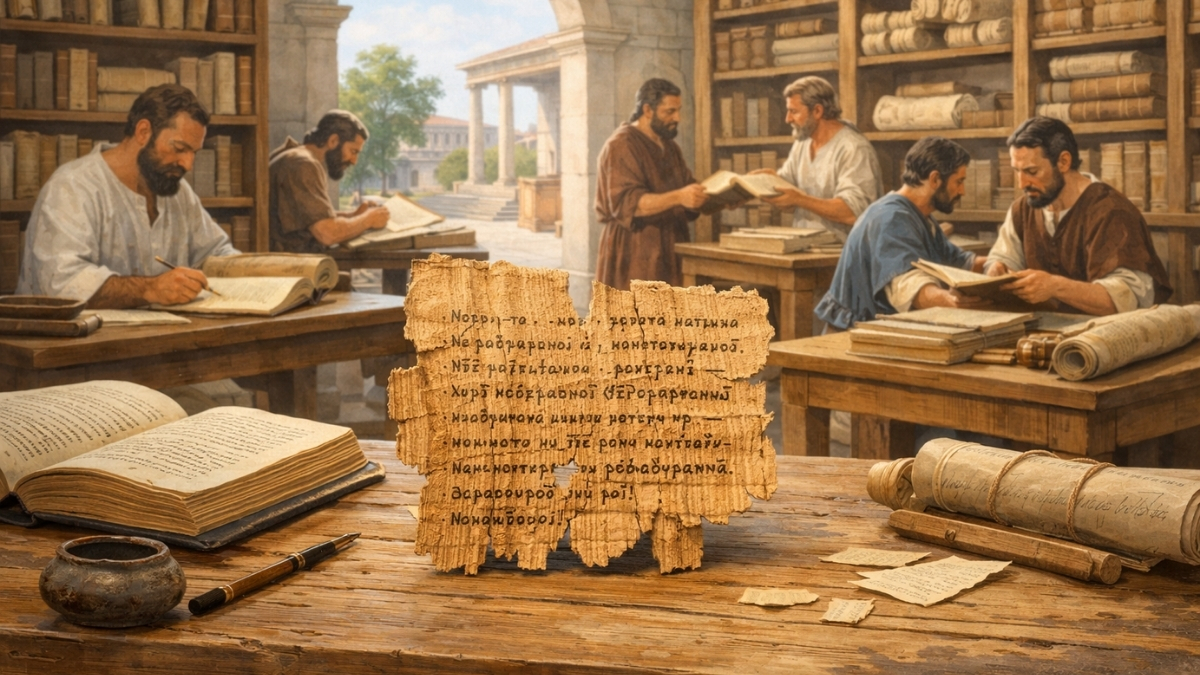
PAPYRUS 14 (P14) is an early copy of the New Testament in Greek. It is a papyrus manuscript written in the form of a codex. The manuscript paleographically has been assigned to the 5th century C.E.
PAPYRUS 2 (P2) Copy of the New Testament in Greek and Coptic
Papyrus 2 (P2) is an early copy of the New Testament in Greek and Coptic. It is a papyrus fragment of a copy of the Gospel of John dating to the sixth century.
How Many Greek New Testament Papyri Manuscripts Do We Have and How Early Are They?
Discover the origins and count of Greek New Testament papyri. Are they as ancient as claimed?
7Q4 AND 7Q5: Cave 7 of Qumran Dead Sea Manuscripts: Are They Fragments of the Gospel of Mark and 1 Timothy?
WHAT DO WE KNOW? Some eminent papyrologists, H. Hunger and O. Montevecchi, have affirmed Marcan identification. Still, the debate of positive Marcan identification goes on; Some papyrologists argue for it, some argue against it, and one scholar has come up with a new identification altogether, namely Zechariah 7:4-5. In addition to proposing Marcan identification for 7Q5, O’Callaghan proposed identification of 1 Timothy 3:16-4:1 for 7Q4.
PAPYRUS 13 AKA P13 (P. Oxy. 657 + PSI 1292) NT Greek Manuscript – Hebrews 2, 10-12
Papyrus 13, designated by siglum P13 in the Gregory-Aland numbering, is a fragmented manuscript of the New Testament in Greek. It was copied on papyrus in the early 3rd century at approximately 225-250 CE. It contains Heb. 2:14–5:5; 10:8–22; 10:29–11:13; 11:28–12:17
PAPYRUS 15/16 sigla P15/P16 (P. Oxy. 1008) / (P. Oxy. 1009) NT Greek Manuscripts
P16 was discovered together with P15. Grenfell and Hunt conjectured that P16 and P15 might have been parts of the same manuscript, written in a documentary hand.
P10 (P. Oxy. 209) Romans 1:1-5, 7 Dating to About 316 C.E.
Papyrus 10 (in the Gregory-Aland numbering system), signed by P10 and named Oxyrhynchus papyri 209, is an early copy of part of the New Testament content in Greek. It is a papyrus manuscript of the Epistle to the Romans.
PAPYRUS 12 (P12) Containing Hebrews 1:1
The manuscript is a letter written by an Egyptian Christian traveling in Rome to his fellow Christians in the Arsinoite Nome, in the Fayum of Egypt.
PAPYRUS 8 (P8) P. Berlin 8683 Early Greek Manuscript Copy of Acts 4-6
Papyrus 8 (in the Gregory-Aland numbering), signed by P8 or α 8 (von Soden), is an early copy of the New Testament in Greek. It is a papyrus manuscript of the Acts of the Apostles, it contains Acts 4:31-37; 5:2-9; 6:1-6.8-15.
Papyrus 101 (P101 – P. Oxy. 4401) an Early Fragment Copy of the Greek New Testament
Papyrus 101 (P101), is an early Greek NT papyrus manuscript of the Gospel of Matthew. The surviving texts of Matthew are verses 3:10-12; 3:16-4:3, they are in a fragmentary condition.


