Discover the significance of one of the oldest New Testament fragments and its impact on historical understanding.
The Papyrus Rylands 457 (P52), a Fragment of the Gospel of John

Updated American Standard Version
Giving Bible readers what God said not what translators think God meant
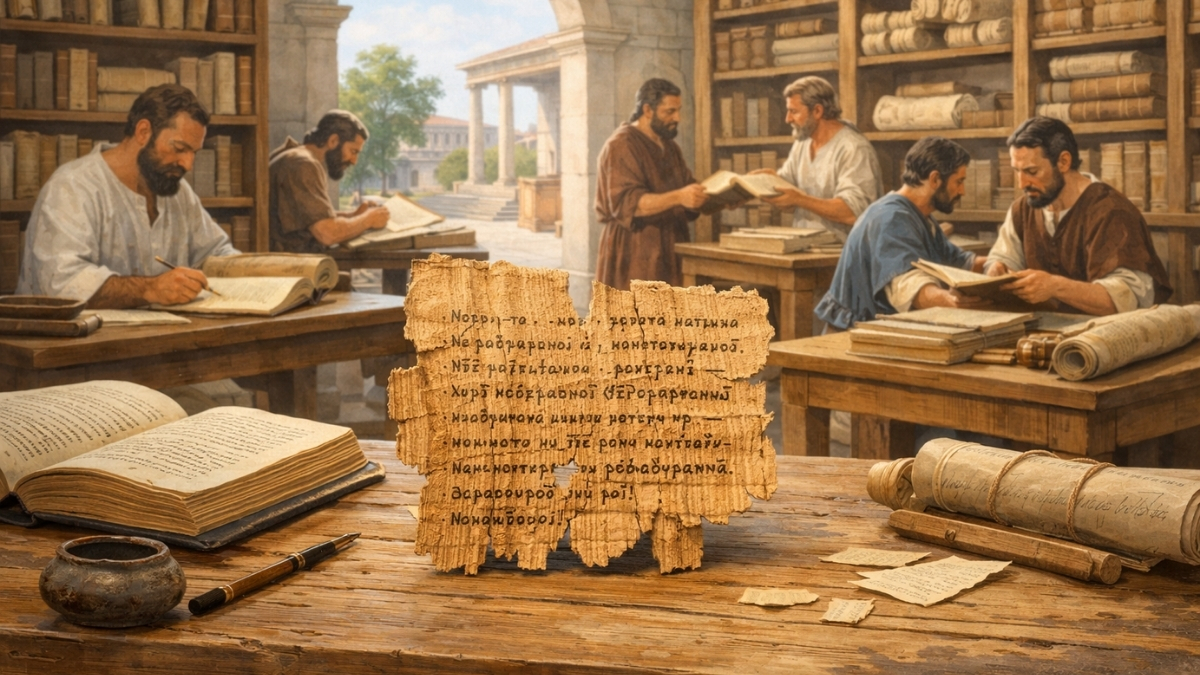
Explore New Testament papyrus manuscripts, their early Greek evidence, dating, textual character, scribal features, and value for reconstructing Scripture accurately.
Discover the significance of one of the oldest New Testament fragments and its impact on historical understanding.

Uncover what was truly written in the early Christian church with Papyrus 30. This ancient manuscript, dating back to 200-250 A.D., contains a portion of the Pauline epistles and is considered to be one of the most reliable early copies of the New Testament. Discover the importance of Papyrus 30 in the study of early Christianity and the establishment of the original readings in the New Testament text. Buy out a few minutes to read this short article and delve into the history of this significant text.

In the case of the New Testament papyri manuscripts, our early evidence for the Greek New Testament, size is irrelevant. They range from centimeters encompassing a couple of verses to a codex with many books of the New Testament. But all of them add something significant.

Why is this fragment of John’s Gospel so valuable to those who love the Bible today? What did the experts conclude about it?

The latest calculations have all known Greek manuscripts at about 5,898, written from as early as 110 C.E. to as late as the end of the fifteenth-century. P52 although a fragment is one of the most important.

The oldest manuscript of the New Testament known today is P52, a small fragment from John’s Gospel, dated to the first half of the second century (110-150 C.E.).

Journey into the P52 Project: refuting the claim that P52 is not the earliest Greek New Testament manuscript for a deeper insight into New Testament Textual Studies.

Interesting;y, the text of 𝔓118 runs straight through Romans 15:33 to 16:1, so it differs from 𝔓46, which has the doxology (usually printed at 16:25-27) immediately following 15:33.

The INTF has paleographically assigned the manuscript to the early 3rd century CE. [200-225 A.D.] Papyrologist Philip Comfort dates the manuscript to the middle-late 2nd century C.E. 150-200 A.D.].

The general rule, the earlier the manuscript, the more accurate. So, the early papyri can validate the original reading for almost all of our textual variants.

